5/19/17

Latrun Conference: Carmel tech demonstrator

First I'd like to thank IsraelDefense.co.il for covering a great deal of information given during the 2nd International Ground Warfare Conference held in Latrun this year, and a thank-you to Sirpad from Fresh.co.il forum who also attended the conference and obtained further images of the Carmel technology demonstrator vehicle that were not posted on the IsraelDefense.co.il website.

General Characteristics

-Halving the weight relative to current vehicles. The goal is 35 tons without compromising protection. A lighter platform will better navigate inside tight urban areas.
-Automatic identification, jamming, and destruction capability for every direct threat on a tank.
-Autonomous engagement of enemy targets as immediate retaliation to enemy fire.
-Increased protection, and significant reduction in the vehicle's signature (visual, thermal, noise etc).
-Multi-layered APS for both point defense and area defense of surrounding assets.
-Real time communication between all surrounding vehicles and units, and ad-hoc communication network for sharing targets.
-More advanced weaponry and ammunition than those currently existing. Hinted non-conventional guns.
-Advanced materials and transparent armor.
-Hybrid drive, smart energy management systems.
-Universal platform.
-Cyber protection for the communication and computerized systems inside the vehicle.
-Protected crew capsule with 3-person capacity.
-2 man crew. Third being a platoon or company commander with equipment to control unmanned assets.
-Dual controls for all crewmen to allow replacement of a crewman without leaving one's station.
-Medium caliber armament of unspecified type. Likely above 30mm and around 40-60mm.

Concept Art
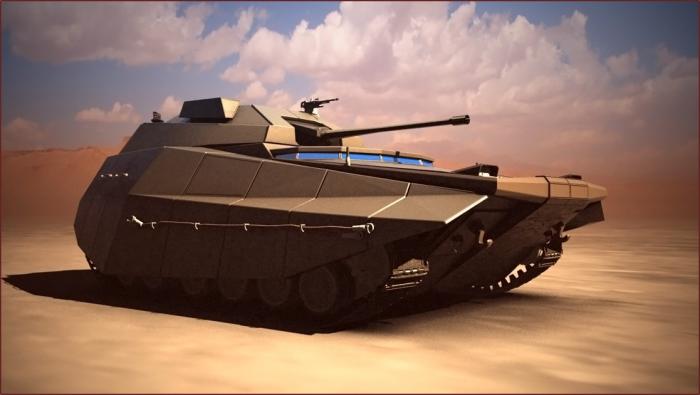
Seen with wide FOV periscopes.

Same version but periscopes are absent.

No rear door.

Family includes APC(?), Recon, CEV, and VSHORAD as well as the standard version.

Okay so let's get down to it, shall we?
The concept art surprised pretty much everyone, including me. But not because of its odd shape, but because it's sloppy.
There is no rear door, so how could the crew enter or exit? There is no V-shaped hull, no APS, and no sights for either the RCWS or panoramic sights.
Not to mention the odd shape of the hull makes little sense. It would be reasonable to provide a higher level of protection to the crew capsule (center portion of the vehicle), but the side armor modules are each shaped differently, which means more different components for the sake of aesthetics which the design team of the concept art is responsible for.
The periscopes take up an immense amount of space and therefore pose a weakspot right above the crew compartment. This is sub-optimal because in an urban environment, top protection is vital. However in one of the pictures it is removed.


For the above-mentioned reasons, I am confident that this is NOT going to be the way the Carmel looks like in the final version. But here are a few details that the concept art does give us:


1)The family of vehicles based on Carmel will replace the Namer which currently serves as an APC and CEV, and will soon be converted to IFV as well. There is no mentioning of a troop carrying capacity for the Carmel yet, but because we see an HMG armed variant, it's likely it will be an APC.
It might be stretched, as opposed to the pictures.

2)Interestingly no MBT variant is shown, which is odd because if it will replace the Namer APC and IFV and Nemmera CEV, it will make the Merkava 4 Barak MBT the only one in the Merkava family without a proper long term replacement plan.

Again, the Carmel will be a highly advanced vehicle with a multitude of advanced capabilities and innovative technologies, but the concept art gives us more doubts than answers.

5/16/17

Latrun Conference: Barak MBT And ATMOS SPH

In time for the 2nd International Ground Warfare and Logistics Conference through May 16-17 and the 4th International C5I (C4I plus Cyber) Conference in May 18th, speeches regarding the development of Armored Fighting Vehicles (AFVs) and developing tactics for their use, are being given.

I took the liberty to translate certain sections of these speeches and post them here, and analyze the new information that we're being given here regarding the Barak MBT, a little on the good old Mark 4, and simultaneously we've received new/old information on the Elbit ATMOS artillery system.

So far, in perhaps just a single release with just a single paragraph of text, a great deal of information was gathered on the Barak, and it was talked about here (link).

Let's dig in!

Another aspect is automation. We need automation systems that provide a real added value. Such systems are almost nonexistent at present. I do not want a robot that the enemy will destroy after a minute and a half. I need robots with automatic and semiautomatic modes of operation. Another layer concerns automatic firing. Wherever the human element is involved in the firing, the result is less favorable. The human element has an adverse effect on the precision and timing of the firing. The systems should provide automatic firing. That is the future. The next model of the Merkava tank will have an automatic firing button. The tank will detect and identify the element firing at it and would discharge a round at the source of fire 30 seconds later. You cannot accomplish that with a man in the loop.
Immediately we're given information about 2 innovations the Barak will have:
*Robots - autonomous or semi-autonomous.
*Automatic firing.
Let's talk about robots first.

UGV

This is really self explanatory. UGVs can provide a plethora of capabilities. I have talked about it in my previous post on the Barak (Link can be found above), so I will make it short by giving a few examples; UGVs can provide force protection by carrying IED detecting and jamming equipment, and if it goes undetected, it will take the hit as it'll go first.
Supply lines will be significantly reduced in areas regarded as vulnerable to ambushes by simply driving a pack of freight UGVs. 

I should mention that the US is now conducting a similar program for drone operating via specialized crewman inside a tank, with feasibility testing beginning this year. Read about it here (link).

But now they're talking about automatic firing in tanks so it should have a pretty serious impact on UGV conception. We could see armed UGVs also conducting automatic firing via sensory cues, and there might be legal implications. But the big news, if it is true, is that the IDF will start fielding armed drones at some point (other than EOD), whereas despite Israel's very strong market presence in this field and vast R&D record, Israel has so far been reluctant about using armed drones.

Automatic Firing

For a first time in manned ground vehicle conception perhaps, automatic firing is being talked not as a possibility, but as an actual plan for a vehicle that is already in development and slated to enter service just 4 years from now (2021).
This topic has been a Taboo. When it comes to firing, a man-in-the-loop always was considered the only moral choice to make, preferably with the shooter actually seeing the target.
For reasons I shouldn't mention, many countries have banned unmanned firing procedures.

But it's not exactly that, and perhaps we'll never even talk about robotized firing on human targets in the conventional sense. Because in this case, it's a part of one fail-safe solution. The fire is retaliatory.

In 2011 Trophy revolutionized armor development by exponentially increasing a tank's protective capabilities at just a fraction of the weight of its armor. But it also introduced other advanced features which include Slew-To-Cue. An enemy would fire upon the tank, and the turret would quickly turn towards the target and await the gunner to pull the trigger. This time it's just a modification of this operation. The FCS (Fire Control System) would no longer wait for the gunner or commander. It would identify the firing source, and shoot on its own. 

Closing the firing loop as fast as possible was a key capability the IDF has been building in the past few years, and this decision will certainly help to improve it.

Net-Centric Combat

Sadly this is hardly ever talked about in Tank and AFV discussions despite being a crucial aspect of the ground maneuver. The flexibility of the maneuvering forces to adapt to the emerging threats is what determines the result of the battle in the most dominant way.

The network will also affect the organization of the Armored Corps. The network should be secure, stable and reliable. During Operation Protective Edge, the network demonstrated stability for the first time. The information should be delivered quickly and must be relevant and accurate. We cannot accept an accuracy level of 20 meters. We need an accuracy level of up to two meters. With the network, the commander will be required to live and operate in a technological environment. The human element will have to accommodate the information, including on-line command. How do you make decisions under such conditions? That is a very serious question.
It may not be immediately obvious but they're talking about the BMS. In the 2014 Operation Protective Edge, the BMS played a key role in the success of the armored corps, by allowing each tank to maintain clear communication with one another, with higher command, and with forces nearby. Improving the BMS is a given, but its merits are not to be underestimated. Even improved UI (User Interface) can go a long way in adding value to the combat vehicle. Communication is all the rage lately, and rightfully so.

This time however, they're talking about integrating entire systems with the BMS. This should include the FCS, IronVision, Trophy, and more.
This sort of added data input will be significant. Commanders will see targets on a helmet display rather than a touchscreen hidden among numerous other screens in his station. Upon being fired on, they'll see the shooter physically, and the tank could engage targets that are visually hidden but seen on the BMS through the FCS.

On Merkava 4's Armor

The Merkava tank does not have reactive armor boxes. Instead, it is fitted with continuous, semi-reactive armor. If you are hit in the same spot, you will still be protected and will be able to sustain additional hits in the same spot. In order to protect the tank crew, you will need a combination of active protection with semi-reactive/passive armor. Anyone who says that active protection is sufficient fails to take into account all of the threats the tank faces
 It was previously speculated that the Merkava 4 has ERA or SLERA (Self Limiting ERA) embedded in its armor due to the picture below:
Translates to Explosive
It was also speculated that the Merkava uses NxRA as armor, judging by this patent by RAFAEL.

But what could they mean by Semi-Reactive? Could NxRA be classified as such? Could SLERA? Both yes. Because they said "Reactive Armor Boxes". Didn't mention "Explosive", and both are indeed reactive in their nature.

The Reactive Armor groups split into 4 main categories;
1)ERA - Most effective per single shot but has poor survivability as it depletes after 1 shot.
2)SLERA - Less effective per shot but more survivable version of ERA. Potentially classified as passive.
3)NERA - Again step down in effectiveness per shot but more survivable. 
4)NxRA - Combines effectiveness of SLERA with survivability of NERA, making it more efficient than both SLERA and NERA, at least according to RAFAEL's patent.

Judging by the currently available information will be tricky, so I will refrain from getting into wild conclusions based on guessing. You be the judge!

A Bit On The ATMOS

Scratch everything I've said so far about the ATMOS and Elbit's proposal. This gun will not be the total mess I predicted it to be, if we're to believe Elbit regarding their plans for the artillery system. This, I believe, is the first time in a long time that they've given us new technical information.

Here goes:
1)The new howitzer will have autonomous engagement as well as fully autonomous loading. A crew of just 1 person is said to be able to make efficient use of the vehicle, as loaders and gunners aren't necessary. The turret will remain entirely unmanned.

2)Crew of 3 or up to 6 may be kept nonetheless if the IDF deems it more appropriate.

3)Each gun will be an independent fire unit. Fire could be directed via a remote Fire Control Center.

4)Testing will continue until the end of summer 2017.

5)Yet unknown whether it will be mounted on wheeled or tracked chassis. They say it won't affect the vehicle's non-mobility related performance.

6)A new precision fire fuze has been integrated to allow cannon artillery a cheap precision fire capability. This would add up to 3 different arrays within the artillery corps to have precision fire capabilities. The fuze is made by IAI and dubbed "TopGun".

7)A restriction on rate of fire of 8 rounds per minute is hinted, but said that it can be simply ignored if there are enough available rounds.

8)The vehicle's computers will be able to select the appropriate shell, fuze, and charge (modular charges) according to the mission without any human input.

Sources

http://www.israeldefense.co.il/en/node/29642
http://www.israeldefense.co.il/en/node/29614
http://www.israeldefense.co.il/en/node/29649

4/4/17

Elbit chosen to supply Israel's future SPH

In an unsurprising move, Elbit was selected as the winner in the "tender" for the IDF's future Self Propelled Howitzer. After a decade of debate, development of a custom built howitzer is now underway. 
This follows months of analysis of alternatives by MAFAT (Research and Development Agency), and consultations with all relevant bodies.

Despite Elbit's victory not surprising anyone, it does appear odd that the winner, Elbit, is the only one in the tender to not actually present a functional system. At least not in the required configuration.

Its ATMOS 2000 has been used by numerous countries and trialed in Israel where it fired several thousand rounds already. But the new configuration it offers to the IDF is said to be completely untested.

The ATMOS 2000 in Elbit's portfolio is a modern and capable system, but is built for export and thus not optimal for IDF's needs. Therefore, it is speculated that the IDF requested the ATMOS's systems and subsystems (e.g gun, GPS, laying system, sensors, FCS) to be transferred to another, existing platform, supposedly a Merkava chassis. 

The Merkava has been the basis for a wide family of vehicles due to its naturally flexible construction, including a prototype howitzer before. 

Another alternative to the Merkava chassis, which was said to be considered, is the M270's chassis. This would allow the IDF to utilize aid money to purchase parts of the SPH and would create a commonality within the artillery corps, as the supply vehicles and MLRS utilize the same chassis.
KMW+IAI proposed the AGM (Artillery Gun Module) that follows this principle, however such decision would be short-sighted, as the supply vehicles are also becoming outdated, and the MLRS could be mounted on the IDF's recently acquired FMTV trucks, utilizing the Lynx architecture by IMI. Effectively creating a HIMARS equivalent.

AGM by KMW and IAI on M270 chassis
HIMARS utilizing Oshkosh FMTV truck and MLRS module


Elbit will develop the new SPH through its subsidiary Soltam. 


http://www.israeldefense.co.il/he/node/29137


4/1/17

IronVision tested on Merkava

Coming much sooner than expected, the Israeli Defense Forces are going to start initial testing phases of the IronVision system by Elbit this month. 

The IronVision is a helmet based system that provides a clear, transparent view of the surrounding area around the tank and feeds the image to the helmet directly, and follows the operator's head movement. 
Among its features are:
* A slew-to-cue mechanism, in which the commander can direct the gun towards the target.
* Ability to operate the tank's weaponry.
* Display of information from the WINBMS (Weapon Integrated Battle Management System).
* Zero latency feed in day and night modes.
* VR training.

Helmet of the IronVision system also featuring night vision mode


Its implementation in the Merkava is part of the Barak program which was described here.

The Barak is a tank based on the Merkava 4 and set to have a functional prototype ready within 3 years. 

The readiness to have the system tested so shortly, indicates that the scope of the upgrade may be far bigger than initially thought, and the IronVision may only be a small part of it.

Israeli Light Tank Prototype

In memory of a prominent contributor to the Merkava project, Yehiam Herpez, a book was written to describe his life work, in the form of interviews of colleagues and friends.

What caught my eye was a unrevealed project the IDF once had - a light tank!

The book can be found here in hebrew:
http://www.himush.co.il/himush.co.il/originals/%D7%A1%D7%A4%D7%A8%20%D7%99%D7%97%D7%99%D7%A2%D7%9D.pdf


Although he participated in the development of every generation of the Merkava and their automotive components and especially suspension, he was most highly appreciated for his success in developing the Merkava 3's suspension, which was considered no less than revolutionary at the time. 
Since the Mark 4 relied on a slightly improved Merkava 3 suspension and didn't take much of the development time, Yehiam was reassigned to the Light Tank project.


The Light Tank was developed in parallel with the Merkava 4 but doesn't seem to be based on any existing vehicle.
Despite having a frontally mounted engine, similar to the Merkava, there is no relation between the two.

It has an MG253 gun, an Achzarit Mk 1's engine Detroit Diesel 8V71TA (radiator moved to the hull floor below crew compartment), and a newly developed torsion bar suspension.


This decision seems odd, as there is no place in the Israeli doctrine for a light tank for many reasons, the most prominent of which are the lack of protection and no need for strategic transportation. 

It was most likely related to the then-efforts to create a future tank based on requirements of low weight and easy transportation. 

The real reason it was ever made is still a mystery.


3/10/17

Merkava 4 Barak

Background

Amid a problematic period for the IDF Armored Corps, several highly important announcements were made. The Armored Corps has a popularity issue, and to be more exact - it is the least popular in the ground forces. In the last incident, 86 men who were conscripted to the armored corps, refused to be enlisted to the corps and demanded to be reassigned to other units, primarily infantry. 
To repair this, the IDF came out in a few statements that will likely bring up its popularity. A very vaguely said one, but perhaps the most important of them all, is the development of a thorough upgrade for the Merkava 4, named Barak.


The Barak is said to be already in development, with a working prototype being ready within 3 years from now.

As a side note; Merkava 3 tanks are also slated to receive the Trophy APS of the upgraded variant, on which I will elaborate further in this post.

Stated features

1)More and larger touchscreens.
2)External cameras.
3)Upgraded Trophy system.
4)Better, BMS, observation and identification systems.
5)Sensor fusion and data fusion.
6)Unmanned Ground Vehicle operation.


What can we infer

1)Makes it practically a "smart" tank that brings it closer to what the youth that operates these tanks is familiar with. Every crew member's interface will be easier to handle.


2)External peripheral cameras existed on Merkava tanks for a little over a decade now. Clearly the mean something else, right? Right. The system at hand is the Elbit's IronVision which is based on Elbit's existing products - JHMCS 2 fighter pilot helmet designed for the F-35 warplane, and STA peripheral camera set that covers a hemispherical view (except the belly) around the tank.

So why cannot the IDF just settle for the STA and wants to go for the highly expensive helmet system? Because using the cameras with a joystick is time consuming in a rapidly changing environment, and it is tedious, which then forces tank crews to peek outside the tank and expose themselves. 


Elbit's IronVision system

A usual setup for the IronVision is 2 helmets - one for the TC, and another for the driver.


3)The development of a Trophy 2 system has been announced in 2014 and is a cooperation between RAFAEL (developer of the Trophy 1), IMI (developer of Iron Fist), and IAI.
IMI will provide its Iron Fist interceptors, IAI will provide the radar, whereas RAFAEL will do the integration and development work.

Iron Fist and Trophy are two very different systems, with very different features that act as their selling points. 


Iron Fist is a "grenade" launching system that applies a fragment-free directed spherical blast that would "cut" an ATGM or RPG mid-air, or will tilt an APFSDS shell to the point where it is no longer a threat. According to IMI's CEO, a simple 7° yaw would reduce the APFSDS's energy by up to 90%.
According to test footage, the yaw was actually far greater than 7°, and was nearing 45°.


At 3:00 a test against APFSDS is shown

Iron Fist provides a full protection suite that would defeat any form of existing fired anti-tank threat, but to do that it needs rather large munitions that cannot be reloaded in the current configuration.

Trophy, on the other hand, uses a much more unique method of firing an MEFP charge (Multiple Explosively Formed Penetrators) that sends sharp pellets flying towards the target. The charges are small and can be reloaded through an auto-loading system beneath it, however these small charges are unable to defeat APFSDS.


One more advantage of the Iron Fist is that it is more compact, and can be more easily applied to lighter platforms, for example the Eitan that will soon enter production. The Trophy is rather bulky in its current configuration when fitted to turreted IFVs.

Trophy HV on LAV III


4)The Merkava 4 is already equipped with a significant array of means to identify hostile elements. Starting with its basic gunner's and commander's sights with multi-channel feeds, to an interconnected BMS shared among the entire ground forces as well as the air force, to the Trophy which is able to pinpoint the location of an ATGM position immediately after firing. 

It could very well mean that another element for search and identification will be used, and among the options is a BMS coupled with the IronVision that provide visual location of a pre-identified enemy, rather than a dot on a flat 2D display. 
BMS are a great thing, but they're only as effective as the operator's ability to comprehend the data.

Even the best conventional BMS is not comfortable to operate


5)Tank Commanders (TC) are often overburdened with information in the heat of battle. Keeping up with constant reports of enemy movement, friendly movement, and ongoing fire exchanges is no easy task, and is highly prone to human error. For example in 2014 operation in Gaza, 5 soldiers were killed from friendly fire, and in an extreme case incident, a tank fired 4 HE shells on another friendly tank located several kilometers away. None was injured. The incident resulted from the TC's lack of understanding of where friendly units are positioned at the moment, and temporary lack of ability to identify the target as a friendly tank.

With the BMS, IronVision, and new communication technologies being implemented in the new Merkava 4 Barak, there is now a chance to integrate them into a single grid that will feed simplified data to the TC and substantially increase the combat capabilities of the tank on an individual level and battle group level.


6)The ability to receive feed from UAVs has existed for quite a long time, but UGVs are a completely different animal.
Although Israel does not yet make killer robots such as the Russian Uran-9, its industries have gained a world leader status in that field. The Guardium UGV has successfully been patrolling the Gaza border and around airfields, as well as in the volatile northern region, the Protector USV has been protecting Israel's ports, and a long line of UAVs have taken Israel Air Force's duty as the most numerous type of aircraft to be flown. 

Israeli industries have showcased a very wide range of solutions based on unmanned vehicles; ranging from logistics, surveillance and convoy protection to decoys and possibly firing platforms.

Perhaps the most creative and cheapest one would be to use masses of repurposed M113 APCs converted for unmanned operation, as supply carriers, forward observation vehicles, decoys for IEDs, and a whole range of missions. They're available in thousands and the conversion is very cheap.
In military terms it's really nothing.

Israel is leading in robotic autonomy development, and so creating a fleet of unmanned vehicles based on M113 for a multitude of missions, would definitely be viable.


What it means

Touchscreens already exist on the Merkava, but improving the interface further and making everything more accessible, will shorten training time and will be another step towards IDF's plans to reduce overall service time, which many criticize as a wrong decision because training time will take up too much of that period.

The ability to see through the armor and into the environment and the higher level of data gathering from new sensors, its fusion into a streamlined and simplified data; will significantly improve the crew's situational awareness and thus their overall effectiveness in all existing combat scenarios.

The Trophy 2 system will likely incorporate an automatic loading system into the Iron Fist's launcher system, giving it a highly durable operation that would allow both defeating tank-fired APFSDS, and deal with high saturation fire from all sorts of threats.

And the ability to control drones would greatly aid the tanks, as a group, in any given scenario as well. It could be a convoy protection vehicle that detects mines and IEDs. It could be a forward observation light vehicle to provide early reconnaissance before the tanks arrive at the scene, thus give it more independence from infantry recon. And even simply cargo carrying vehicles.
Israel is constantly pursuing independence of its military units on every level. Starting with independence of every branch to conduct all forms of operations, to battalion size independence. Such overlap of capabilities ensures resilience of the combat units even when taking heavy losses.

It also gives the tank crew up to brigade level, more accessible information and thus more freedom to make actions.


All in all, the tank will become a lot easier to operate, and a lot more comfortable. Comfort and ease of operation are essential for the crew to fulfill the machine's potential as much as possible, and are key for increased performance both on the individual level, and on the theater.

The addition of Trophy APS to a wider range of vehicles is also a revolutionary action for the IDF. Just 2 years ago it was still a system that only those who enlist to the 401st brigade could get the opportunity to play around with. Now it's operational in 2 brigades and a host of other units are getting it - Namer, Eitan, and Merkava 3 have all joined in through a massive purchase of hundreds of APS systems from RAFAEL.
The IDF will thus not only have a sperheading brigade in its sleeve. It will have at least two divisions rolling with it.

Conclusion

The envisioned Merkava 4 Barak upgrade plan is no less than revolutionary. Even if it isn't a Merkava 5, as it is still very much based on the existing Merkava 4, its capability leap can be seen as greater than the leap between every generation of Merkava tanks.

Each generation of Merkava introduced a farther leap in capabilities than the predecessor, and the Mark 4 Barak seems to provide just the revolutionary capabilities that make it more of an improvement than the Mark 4 was over the Mark 3.

So while it isn't a Merkava 5, it could certainly qualify as such.

And why isn't it a Mark 5? Because the concept of the Merkava 4 pretty much makes it a very long lasting machine. Its modular armor construction ensures it can grow enough to protect against any future threat, as the older armor modules can be switched out with newer ones with bare minimal cost.
Its FCS architecture is also modular, and easily accepts new emerging technologies. 
The engine bay allows for plenty of room for engine exchange. 
And the gun mantlet was built in a way to accept even the much larger and heavier 140mm guns (in cooperation with Switzerland), so even if a certain firepower upgrade is needed, it won't be expensive.


The Merkava 4 is envisioned to stay in service for a very long time, and in parallel the Rakiya - the next generation of combat vehicles, will be developed and produced.

1/25/17

New Eitan Info

Doing just a little update since I've received new information regarding the Eitan. 

*Eitan is confirmed to have 30mm cannon.
*Namer will be trialed with the new cannon as well beginning next year.
*new touchscreens.
*off-road speed during trials is 50km/h for safety. Said to increase in operational activity.
*Improved synchronization of battle management systems and communications with the fire control systems.
*currently going through final operational assessment phases, soon will have an assigned schedule for acquisition.
*some faults discovered, mainly communication between commander and driver. Now being fixed.


I must say, I'm quite disappointed with the choice of 30mm cannon (XM813) as it provides a lower degree of firepower than a 40mm, and is left behind in the trend of higher caliber munitions, led currently by UK, France, Spain, Russia, and China, and in the long run also the US. 

The 30mm may be enough for Israel at the moment, but looking at the future and the IDF's current focus on a mix of hybrid and mobile warfare, it may not be enough in the long run. It's important to note that at the moment, the IDF does not operate a medium cannon, and as such it doesn't face the logistical constraints of ammo commonality.

However there is quite a logical reason behind the IDF's choice of 30mm over the 40mm.
The current suppliers of cannons and ammo for the 40mm CTAS are France and UK, both are deemed by Israel to be unreliable arms exporters, since both have imposed embargo on Israel, with the latter doing so just a few years ago.

Developing locally would be too time consuming and resource consuming. The IDF only chose to develop its own armament when access to foreign cannons was denied.


The Really Big News?

Namer is said to be trialed with the same turret to provide alternative fire for tanks that may not be around.
For years the debate around Namer's firepower has been central in every discussion regarding its development, and now it is finally here.

Namer has already been tested with 30mm turrets before, namely the RAFAEL Samson 30 Mk-1 and Elbit's UT-30, however it was decided to not purchase either and not to pursue a more suitable one, since these were mainly export oriented turrets.

Namer with Samson 30 Mk 1 turret in trials


What this means essentially is that the IDF will now have not one, but two true IFVs allowing it to operate true mechanized infantry with independent firepower capabilities which include precision strike at long ranges via Spike missiles.

http://www.ynet.co.il/articles/0,7340,L-4912534,00.html